New modeling by Mainz physicists shows that microscopic primordial black holes might have reheated the young universe after its initial expansion.
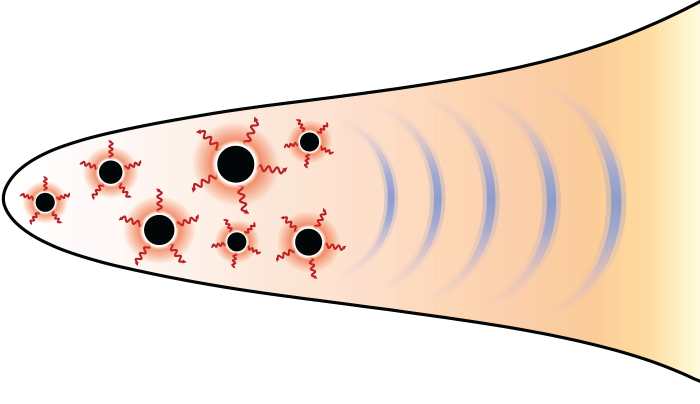 An early universe filled with tiny black holes: As space expands (from left to right), primordial black holes of different sizes gradually evaporate (red) and finally explode. In doing so, they reheat the universe and give rise to the “hot” Big Bang (orange). The reheating may also have sent faint ripples through spacetime, known as gravitational waves (blue). Image Credit: Nicholas Leister/JGU
The question of what happened in the universe’s very first seconds is a central one in cosmological research. One theory puts primordial black holes into the spotlight: Since black holes gradually evaporate and finally “explode”, they may have done so during the universe’s first second as well.
New modeling by theoretical physicists in the work group of Dr. Pedro Schwaller at Johannes Gutenberg University Mainz (JGU) as well as from the Institut d’Astrophysique de Paris shows that primordial black holes might have been responsible for reheating the universe a second time, and thus for generating the hot plasma from which our material universe formed. The team has published their findings in the latest edition of Physical Review Letters.
“There is strong evidence that the universe went through a phase of extremely rapid expansion right at its beginning, known as inflation,” said Schwaller, theoretical physicist at JGU and PRISMA++ Cluster of Excellence. According to this picture, the very early universe underwent a period of exponential expansion from 10−35 to 10−33 seconds into its existence. Afterwards, the universe was supercooled and had to be reheated, filling it with hot matter and radiation. “But between this reheating and the earliest processes we can trace today, such as the formation of the first atomic nuclei, we know surprisingly little about what happened,” Schwaller explained.
This leaves room for surprises. Tiny black holes could have formed shortly after inflation. As space kept expanding, the hot radiation thinned out and cooled much faster than the black holes, until they dominated the universe.
The universe would have supercooled once again, consisting of little more than expanding spacetime and some singularities, meaning black holes. When these finally evaporated and exploded, they would have reheated the universe a second time, giving rise to the “hot” Big Bang whose traces we observe today.
The JGU research team took a new approach to modeling which shows that black holes smaller than a single atom may be the source of this second reheating. In this sense, us and all of our universe could be the remnants of tiny black holes.
Black Holes as Heaters of the Universe
As Stephen Hawking discovered, black holes don’t last forever. Their lifecycle includes a slow evaporation with a final “explosion”. The larger the black hole, the longer this lifecycle. Nicholas Leister, physicist in Pedro Schwaller’s work group: “The assumption of earlier research was that primordial black holes were all the same size and thus vanished at the same time. Such an event triggering the reheating of the universe after inflation was unlikely, since a sudden burst of that magnitude would have produced a very strong ‘Poltergeist’ gravitational wave signal, much stronger than we have thus far detected in the gravitational wave background.”
This assumption of homogeneity in black holes is also not compatible with predictions based on Einstein’s theory of general relativity. Rather, a variety of masses for the primordial black holes would be expected. This would in turn lead to gradual evaporation over time, with the lightest going first.
“We are really speaking of ultra-light black holes that could have dominated the very early universe,” said Leister. “The smallest primordial black holes may have been smaller than an atom. But since they would have held almost all of the universe’s energy, their explosions could have filled the entire cosmos with the hot plasma from which matter formed.”
Modeling the First Microseconds of the Universe
To test their theory of ultra-light primordial black holes reheating the young universe, the researchers employed advanced modeling techniques that capture a realistic population of black holes with different masses and lifetimes. This allowed them to identify the conditions under which such a “gas” of black holes could have dominated the early universe and to improve our understanding of the reheating period.
The team found that their calculations apply to a broad range of scenarios for how primordial black holes formed. However, they also found that the gravitational wave signals expected from the reheating are suppressed: Because black holes of different masses explode at different times, the universe heats up gradually rather than in one sudden burst, and the resulting ripples in spacetime remain faint. Nicholas Leister: “Future gravitational wave experiments probably won’t be able to probe this theory. But our findings do open the window to further cosmological research by showing that a primordial black hole-dominated early universe is possible.”